Wednesday, February 18, 2015

Snuff Spoons or Early Salt Spoons?

Geoffrey Wills, in his book Silver: for pleasure and investment, has this to say about salt spoons: "[E]arly eighteenth century examples are miniatures of ordinary spoons.  They were followed by some in the shape of a ladle and others with a bowl in the form of a shovel."  He goes on to say the following about snuff spoons: "[M]iniatures of ordinary spoons were made during the eighteenth century for keeping inside a box to assist in taking snuff" (130).

I recently found two small rattail spoons, pictured below.

Left to right: Spoon by Andrew Archer and spoon by John Ladyman
Top to bottom: Comparison of Ladyman marks on snuff spoon (left) and tablespoon (right); Archer marks.  Can you make out the lion's head erased?

Size comparison of spoons, left to right: Archer snuff spoon, Ladyman snuff spoon, Ladyman teaspoon, Ladyman tablespoon

The first, by Andrew Archer, is 3 1/8 inches long and, if I squint my eyes just right, the second mark looks like the lion's head erased.  For its size it has a good gauge.  The second spoon is just over 3 1/4 inches in length and is made by John Ladyman.  The complete maker's mark is not present, but comparing it to other pieces in my collection with his mark, I feel confident attributing it to Ladyman.  The lion's head erased is clear.

So, are these snuff spoons or early 18th century salt spoons?

Sources:
Wills, Geoffrey.  Silver: for pleasure and investment. New York: Arco Publishing Company, Inc., 1969. Print.

Wednesday, December 17, 2014

Early Silver Dessert Spoons

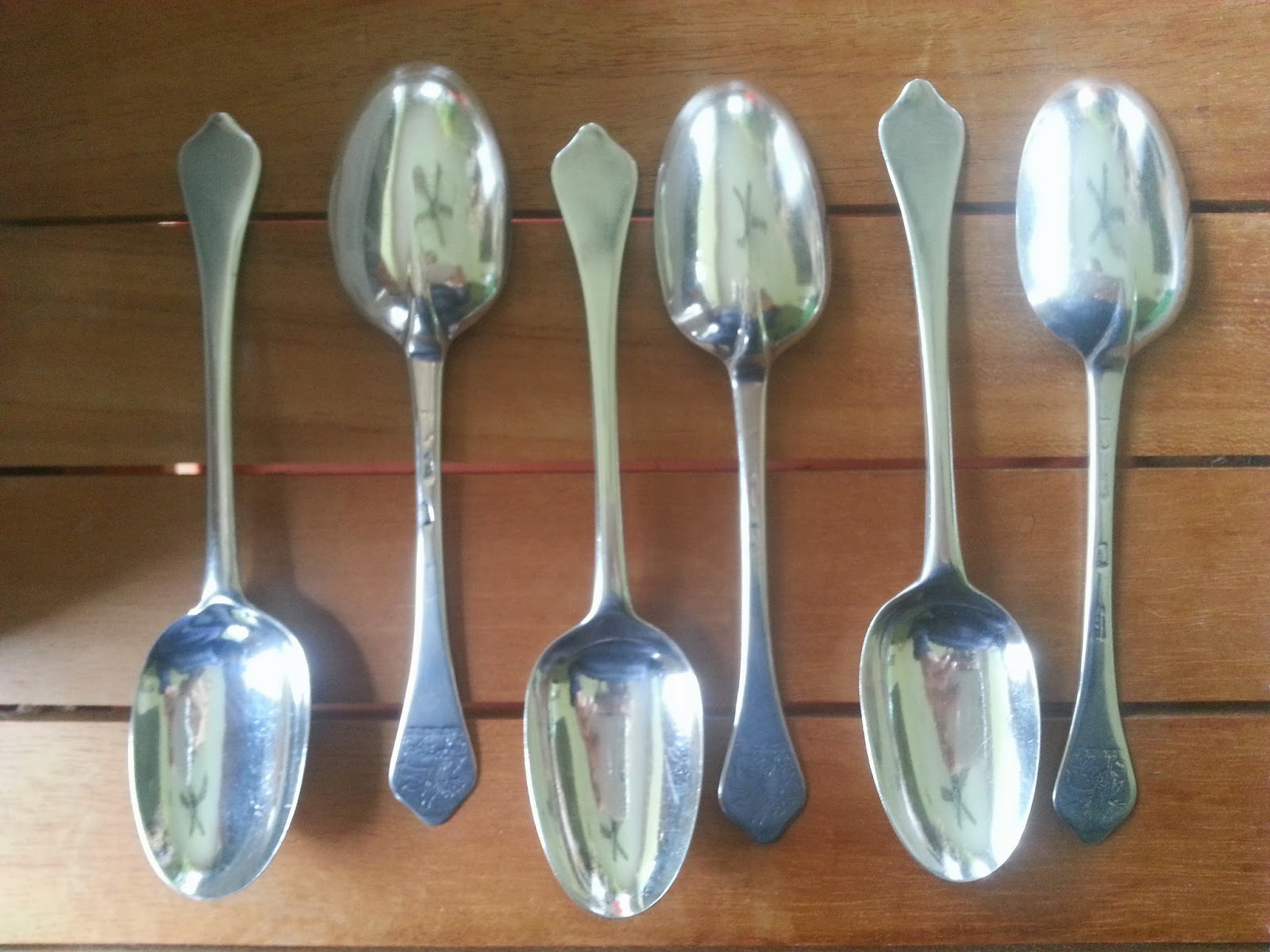
John Ladyman dessert spoons with engraved crest of a griffin
When did dessert spoons first make their appearance?  In the Queen Anne and George I section of his Christie's Pictorial History of English and American Silver, Michael Clayton tells us that "[s]maller-sized table silver for 'dessart' appeared at the same time, but it should be remarked that even at this early stage they were made in smaller numbers than table-sized pieces, and for this reason are consequently rare.  They were also liable to succumb to wear and tear rather more easily" (100).  I take "the same time" to mean about the turn of the 18th century, since this is the period referenced earlier in the paragraph.

Eric Delieb, in his Investing in Silver, illustrates a William III dessert-size trefid spoon by William Scarlett of 1700 which is 5 3/4" long (15).  In the Dreweatt's & Bloomsbury Auctions archives is a listing for the sale of a William III trefid dessert spoon by William Matthew I of 1697 which is 6" long.  The Postal Auction section of the November/December 2011 issue of The Finial, Lot 79, lists a pair of Queen Anne dognose dessert spoons by Thomas Sadler dating from 1707 being 6 1/2" long.  Earlier this year, Sotheby's sold a beautiful set of 12 silver-gilt dognose dessert spoons made by Pierre Platel engraved with the arms of Sir John Stonhouse, 3rd Baronet of Radley.  The spoons bear Platel's maker's mark only, and their length is not provided.

A cursory internet search did not turn up any early Irish silver dessert spoons.  Do any of you know of any out there?

A few years ago, I bought a set of six Queen Anne dognose dessert spoons dating to 1702 by John Ladyman.  The spoons are 6 1/4" long and each is engraved with a wonderful crest of a griffin.  Confirming Mr. Clayton's remark, my set of dessert spoons has succumbed to wear and tear, with the hallmarks and the rattails being fairly worn.

Set of six dessert spoons, John Ladyman, London, 1702

Close-up of hallmarks on Ladyman dessert spoon

My spoons have seen their fair share of 'dessart,' so I'd like to think I've done Mr. Ladyman proud. And, I'm happy to find that, in Mr. Clayton's opinion at least, I own a set of rare spoons.

Spoon: John Ladyman, 1702.  Ice cream: Ben & Jerry's Half Baked.

Sources:
Bexfield, Daniel, ed. The Finial 22/02 (Nov/Dec 2011): 25. Web. 12 Oct. 2014.
Clayton, Michael. Christie's Pictorial History of English and American Silver.
       Oxford: Phaidon Christie's Limited, 1985. Print.

Delieb, Eric. Investing in Silver. New York: Clarkson N. Potter Inc., 1967. Print.

Sunday, October 26, 2014

The Life and Times of John Ladyman (with some Irish Gold Tea Implements Thrown in for Good Measure)

Maker's mark of John Ladyman
As readers of this blog know, I have a thing for silversmith John Ladyman.  I don't own a copy of Grimwade's London Goldsmiths, but as a member of The Silver Society, I have access to their database of information extracted from said tome.  Although I am sure the print version of Grimwade contains additional details, the information I can access shows that John Ladyman entered only one mark between January and July 1699 as a largeworker.  Between 1691 and 1713, Ladyman's address is listed as Sherborn Lane, and after 1724 it is listed only as London.  I do wonder why Ladyman entered as a largeworker, since the only pieces I have seen by him are spoons.

John Ladyman married Sarah Wilson on September 27, 1691 at St. James church in Duke's Place, London (Phillimore 39).  As far as I can interpret from The Transcripts of the Registers of the United Parishes of S. Mary Woolnoth and S. Mary Woolchurch haw, John and Sarah had six children:

- Elizabeth, baptized April 29, 1692 (based on the date of the marriage and Elizabeth's baptismal date, does this mean Sarah was pregnant when she married John?);
- John, baptized November 5, 1693 and died on January 31, 1694;
- Mary, baptized November 19, 1695;
- Thomas, baptized June 10, 1697;
- John, the only entry being that he was the "infant and son" of John Ladyman who died on November 10, 1697 and was buried on November 11; and
- John, baptized January 6, 1699
(Brooke and Hallen 77, 78, 80, 82, 85, 260, 264)

Since there is not a separate entry for the baptism of the John who died on November 10, 1697, I assume he was born and died the same day.  These entries also make me wonder how quickly after birth children at this time were baptized; take for instance the first John who was baptized just over 6 months after Elizabeth, implying - only if John was baptized very quickly after his birth - that Elizabeth was born at least three months before her baptism.  Same query with the birth-baptism intervals of Thomas and the second John.  Of course, there could also have been errors in the original registers or they could have occurred during transcription.  I am unable to find a record of John Ladyman's death.

Five gold teaspoons by John Ladyman, 1711, along with sixth teaspoon, sugar nips and mote spoon, Dublin post-1730.  Photograph credit: The Metropolitan Museum of Art, Gift of Mrs. Edward S. Harkness, 1927.  www.metmuseum.org

The most interesting pieces by John Ladyman that I have come across are a set of five teaspoons made of gold dating to 1711 in the collection of the Metropolitan Museum of Art.  The five Ladyman teaspoons are shown with another later teaspoon, a mote spoon, and a pair of sugar nips all made of gold and all made in Dublin post-1730.  Each piece is engraved with a K surmounted by an earl's coronet, which the museum states could possibly be for the Earl of Kerry, a title created in 1722.  Now, if there are five of these gold teaspoons, a sixth presumably existed at some point, since a half-dozen was the norm.  What happened to this sixth gold spoon?  Who commissioned John Ladyman to make these golden teaspoons in the first place?  If the MMA is correct and the engraving is for the Earl of Kerry, the engraving cannot be contemporary to the manufacture of the 1711 Ladyman teaspoons.  Was there an original engraving on the backs of the teaspoons that would have given us a clue to their first owner?


Gold teaspoon by John Ladyman, 1711.  Photograph credit: The Metropolitan Museum of Art, Gift of Mrs. Edward S. Harkness, 1927.  www.metmuseum.org

To date, my small collection of pieces by him includes three tablespoons, six dessert spoons, and two teaspoons, all in the Hanoverian rattail style.

Front and back of three tablespoons, 1712, two (of a set of six) dessert spoons, 1702, and two teaspoons, all by John Ladyman
Engravings on the terminals of John Ladyman spoons


Sources:
Brooke, J.M.S. and Hallen, A.W.C. The Transcript of the Registers of S. Mary Woolnoth and S. Mary Woolchurch, haw, in the City of London, from their 
      Commencement 1538 to 1760. London: Bowles & Sons, 1886. Google Books. Web. 11 Oct 2014.
Phillimore, W.P.W. and Cokayne, George E., eds. London Parish Registers. Marriages at St. James's , Duke's Place, From 1691 to 1700. Vol. III. London: Phillimore 
      & Co., 1901. Internet Archive. Web. 11 Oct 2014.

Saturday, October 11, 2014

Engraving on Flatware

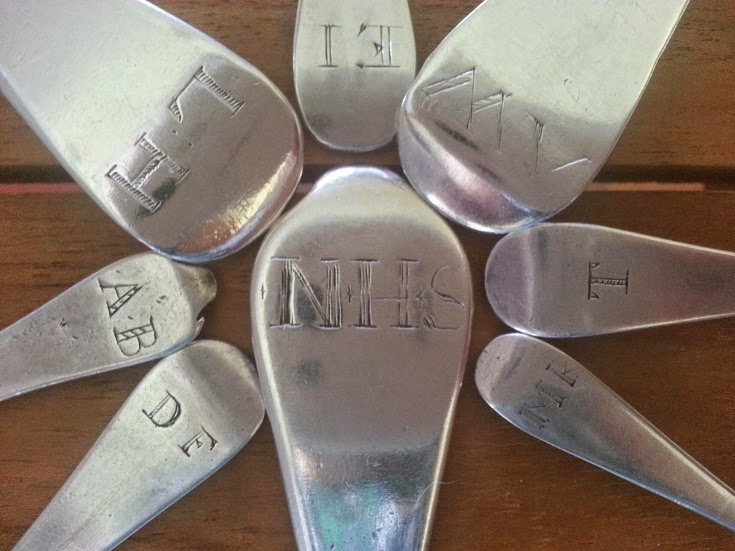
Following are photographs of the engravings on the backs of my spoons and forks (essentially a reprise of my first post with a few new additions).  Each of the engravings is unique, and has become an effective way to identify the utensil.  My husband's favorite spoon is the Owl Spoon.  I, of course, have several "favorites"...  Recently, I was excited to find a little teaspoon engraved "MK," M being the first letter of my name and K being that of my husband's.

Gary Bottomley of Antique Silver Spoons tells us that one set of initials, as on all of the flatware in the first photograph below, could indicate that the spoon was given as a birth, christening, or baptismal gift.  Or, the initials could be that of the adult owner, usually the man if he were married.  I assume a single set of initials could also be those of a single or widowed woman.

Whatever the type of engraving - initials, cypher, crest, coat of arms - it served to identify the owner of the piece.  In the most recent edition of The Finial, Robin Hunt sent in an ad from the March 7, 1694 edition of The London Chronicle, which offers a reward for information about a stolen silver spoon and fork identified as being engraved with a "Tygars Head."


What are your favorite engravings on your flatware? 

Initials:
 
Coat of Arms:

Cyphers:

Crests with Mottoes:

Crests - Mural Coronets:


Crests - Human Forms:

Crests - Animals:

Crests - Birds:

Sources:
 Bexfield, Daniel, ed. The Finial 25/01 (Sept/Oct 2014): 12. Print.

Monday, August 25, 2014

Deep Thoughts on Early Condiment Spoons and The Mustard Caster

Item 33 in Christopher Hartop's Geometry and the Silversmith: The Domcha Collection is a trio of attractive octagonal baluster casters by John Chartier made in 1719 (50).  The large caster is 7 7/8 inches tall and the pair of smaller casters is 5 7/8 inches tall by 2 1/4 inches in diameter (Ibid.).   Below is a photograph of these same casters for sale with S.J. Shrubsole:

Set of three casters by John Chartier, London, 1719.  Photograph courtesy of S.J. Shrubsole.
Mr. Hartop notes that "[i]t is evident that these sets of casters were used for sprinkling ground substances on food..." and states that sugar is the likely candidate for the large caster and mustard and ground pepper for the smaller (Ibid.).  However, he notes that "the idea prevalent among silver writers that mustard was sprinkled as a powder on to meats is not documented (Ibid.).  Mr. Hartop then cites contemporary descriptions of mustard as being mustard seed mixed with other ingredients to make a paste, and suggests that, because some smaller casters have "blind" covers, it was the paste version of mustard that was served from them (50-51).

If it was the case that powdered mustard was not used and that mustard paste was, how was the mustard paste transferred from the caster to the diner's plate?  Since the covers were blind, the diner could not pour the mustard through the piercing onto his or her plate.  Even if the caster were not blind, this method would seem to have been fairly messy.  This suggests that the diner had to remove the top of the caster in order to get at the mustard.  Where, then, did the top go?  A possible answer is found in a photograph in Michael Clayton's Christie's Pictorial History of English and American Silver.  This photograph shows a cruet frame of 1719 holding glass bottles and three silver casters of 1724 (104).   Cruet stands typically have a lower surface that the containers rest on, as well as elevated rings of silver to hold the containers in place when the stand is picked up by its central handle.  The photograph in Clayton's book shows two rings of silver without a lower surface, and in one of these rings rests the top of a caster (Ibid.).  So, it would appear that the lid to the mustard caster would be set into one of these rings.

There must have been a spoon for dipping the mustard out of the caster.  I assume that each guest was not provided with their own mustard spoon, meaning that the spoon stayed in the caster.  The spoon, of course, would need to be tall enough to stand above the caster rim.  Mustard spoons and small ladles are widely found from the George III period, but they don't seem as numerous from earlier periods.  Millicent Ford Creech has for sale what is described as a rare early 18th century Hanoverian rattail mustard spoon.  It is 2 1/2 inches long (which doesn't seem tall enough to stand above the caster rim, so perhaps this smaller spoon was rested on a small dish or the diner's plate after use and did not stand in the caster).  David Whitbread, in the  20/05 edition of The Finial , discusses early tea and condiment spoons and illustrates several from his own collection.  What I find interesting and very practical is his statement that, "...as well as using [them] for tea, earlier owners could have also used [them] to eat sweetmeats or a boiled egg, to take medicine and for any other purpose appropriate to [their] size" (10).  Those in his collection that have "outsize bowls" he has been told are condiment or spice spoons (11).  David McKinley, in a follow-up article to Mr. Whitbread's in the 20/06 edition of The Finial, also says that a large bowl in proportion to overall spoon size has been said to indicate its use as a condiment spoon, but is unsure why this should be the case (8).  Perhaps these spoons with the outsize bowls were mustard spoons used with these early casters, but it could just as well be the case that small spoons we know as teaspoons could also have been employed for the purpose.

Is it possible that black pepper and cayenne pepper were used in the non-blind casters in a set of three?  Perhaps, but there are order accounts which imply that sugar, pepper, and mustard were the great triad of caster condiments: In 1689, William Fitzhugh of Virginia ordered from London "a Sett of Castors that is to say for Mustard, Pepper & Sugar (Hartop 50); and the Earl of Orford was sent "sugar pepper and mustard casters" (51). 

If mustard paste was served from a caster, was it the resulting inconvenience that caused the silver mustard barrel/pot to come into being?  In 1724, Horatio Walpole was issued two mustard barrels and two spoons from the Jewel Office (Hartop 51).  Walpole also received two mustard glasses in this order (Ibid.).  I am not sure if these mustard glasses were inserts for the silver mustard barrels, or if they stood as mustard containers on their own, perhaps used when dining en famille.  Mr. Hartop notes further that by the third quarter of the 18th century, the mustard caster was being replaced by the mustard pot (Ibid.). 

Sources:
 Clayton, Michael. Christie's Pictorial History of English and American Silver.
       Oxford: Phaidon Christie's Limited, 1985. Print.

Hartop, Christopher. Geometry and the Silversmith: The Domcha Collection.
       Cambridge: John Adamson, 2008. Print. 
McKinley, David. "Further Thoughts on Early 18th Century Small Spoons." The Finial 20/06 (Jul/Aug 2010): 8.   
      Web. 17 Aug 2014.
Whitbread, David. "Trefid Tea and Condiment Spoons." The Finial 20/05 (May/June 2010): 10-11. Web. 17 Aug 2014.


Tuesday, August 12, 2014

Early Irish Silver Teaspoons (Where are They?) and Streets Named For Dublin Silversmiths

Lately, I have increased the number of teaspoons in my collection and have enjoyed using the little utensils.  This evening, it's the trefid:


All of my teaspoons, save the trefid, are Hanoverian rattails.  While stirring my tea, thinking about silver (as one does), a thought occurred to me: Why have I never come across an early Irish rattail teaspoon?  Early English rattail examples are relatively easy to find, but in the retail setting - and in the fairly limited books I own and museums I have visited - I have not seen even one early Irish teaspoon.  Even knowing that early Irish flatware is not as profuse as its English counterpart, I would have expected to have seen at least one or two early Irish examples.  Does anyone know of any early Irish teaspoons out there?

Now, on to another topic concerning Irish silver.  In a Lot Note from Christie's, I read the following statement with interest: "David King was one of three Dublin goldsmiths honoured for his services to the trade by having a street named after him."  Since Christie's doesn't mention the other two goldsmiths, I was curious to find out who they are.  While there is a South King Street and a North King Street, an entry in Weldon's silver blog states that South King Street is our man.  Weldon's blog describes Mr. King as a "superb early silversmith" and illustrates examples of his work.  David King was Master of the Company of Goldsmiths from 1699-1700 and was a member of the lower house - the Sheriffs and Commons - of the Dublin Corporation, now known as the Dublin City Council.  Mr. King became a freeman in 1690 and died in 1737 (Bennett, 147).

Photo of the Gaiety Theatre on South King Street.  Photo courtesy of GraftonStreet.ie
The second Dublin silversmith I found to have had a street named after him is Jeremiah D'Olier.  Douglas Bennett (142) tells us that Mr. D'Olier was born in 1747, became a freeman in 1770 and was elected Master of the Company of Goldsmiths in 1781.  Like David King before him, Mr. D'Olier was elected to the Sheriffs and Commons, and he was made a Sheriff's Peer in 1790 (Ibid.).  He was a founder of the Bank of Ireland and, according to Wikipedia, a member of the Commissioners for Making Wide and Convenient Ways, Streets and Passages, which you can read more about here.  Mr. D'Olier died in 1816.

D'Olier Street.  © Copyright Eric Jones and licensed for reuse under this Creative Commons Licence
I thought I was stumped on the third one, until I re-read Chapter 7 of Douglas Bennett's Collecting Irish Silver, which identifies Thomas Bolton as the third man.  According to Bennett, Thomas Bolton was made a freeman in 1686, was Master of the Company of Goldsmiths from 1692-1693, and was the Assay Master between 1692 and 1697 (139).  Henry F. Berry, in a paper published in The Journal of the Royal Society of Antiquaries of Dublin (127) notes that on November 1, 1696, Thomas Bolton presented the Company of Goldsmiths with a large green tablecloth as a gift.  I suppose the premises needed some sprucing up.  When the new Goldsmiths Hall was being built, the Company decided to sell some of its plate - two silver bowls with covers and two large silver cups - to go towards the cost of the hall.  Thomas Bolton was the purchaser (131).  One wonders if Bolton kept these items for personal use, or sold them.  Thomas Bolton also made a loan of 200 Pounds to the Company to help with expenses of the new hall (McCormack, 116).  In 1716, Mr. Bolton was elected Lord Mayor of Dublin.  The Company of Goldsmiths presented a pair of cups engraved by Jonas Heaven to Mr. Bolton valued at 35 Pounds to mark the occasion (Bennett, 135).  However, towards the end of his life, Mr. Bolton experienced money troubles.  In 1730, he applied to the Company for a pension, and "our reduced brother" was given 10 Pounds a year until his death in 1736 (McCormack, 116).  For a more in-depth look at the life and work of Thomas Bolton, see John McCormack's article from the Irish Arts Review.

Dublin Institute of Technology building on Bolton Street.  Photo courtesy of Flukey's Virtual Walking Tour of Dublin


Sources:
"Antique Irish Silver Maker's Marks from A-L." Weldons of Dublin, 25 July 2013. Web. 12 Aug 2014.
Bennett, Douglas. Collecting Irish Silver. London: Souvenir Press Ltd., 1984. Print.
Berry, Henry F. "The Goldsmiths' Company of Dublin (Gild of All Saints)." The Journal of the Royal Society of 
     Antiquaries of Ireland 6.5 (1901): 119-133. Google Books. Web. 13 Aug 2014.
"D'Olier Street." Wikipedia, The Free Encyclopedia. Wikimedia Foundation, Inc. 29 Dec 2013. Web. 12 Aug 2014.
McCormack, John. "The Sumptuous Silver of Thomas Bolton (1658-1736)." Irish Arts Review 11 (1995): 112-116. JSTOR. Web. 13 
     Aug 2014.

Tuesday, May 6, 2014

Reunited and it Feels so Good: a Set of Three Rattail Teaspoons

About a year ago, I purchased this Britannia-standard teaspoon:

Britannia-standard teaspoon, Samuel Hitchcock, London

Close-up of hallmarks and initials

The teaspoon was made by Samuel Hitchcock, who, according to Jackson's Silver & Gold Marks, entered his first mark in 1713 (164).  From general research it appears that Mr. Hitchcock was by and large a spoon maker.  The back of the teaspoon is crudely initialed "EI."  The one feature on this teaspoon that stands out is the shape of the punch around the lion's head erased.  To date, I have not seen the lion's head erased in the same shield-shaped punch...that is, until about a week ago.

About a week ago, I spotted a pair of Britannia-standard teaspoons by Samuel Hitchcock.  Not only is this pair engraved with the same crude "EI," but they are also marked with the lion's head erased in the same shield-shaped punch.

Here is the pair of teaspoons:

Front and back of pair of Britannia-standard teaspoons, Samuel Hitchcock, London

Close-up of hallmarks and initials on pair of teaspoons
I always keep an eye out for spoons or forks that match those I already have, but the closest I've come is finding a set of tablespoons with the same stork crest, but the maker and date were different.  Now, of course, I'm convinced that there are three other teaspoons out there matching these just waiting to be found.  The hunt is on!

Together again at last


Sources:
Pickford, Ian, ed. Jackson's Silver & Gold Marks of England, Scotland & Ireland. 3rd ed., 1989. Woodbridge: 
       The Antique Collectors' Club, Ltd., 2011. Print.