Wednesday, April 1, 2015

George III Irish Silver Bowl - *GASP* It's a FAKE!


~Below is my original post on the bowl.  After posting it, I received a nice note from a reader letting me know this bowl is a fake.  At the end of this post is more information on the faker~

Below is an Irish silver bowl that dates to 1798 in the reign of George III.  Although the bowl is later than I normally collect, it reminds me of earlier forms.  It measures 4 1/8 inches in diameter (10.5 cm) and 2 3/8 inches (6 cm) in height, is of heavy gauge, and is plain with a lovely hammered finish.

Strawberries.  Yum.

The maker's mark on the bowl is IE surrounded by pellets.  Unfortunately, I haven't been able to attribute this mark to a silversmith.  The only Dublin maker's mark of IE referenced by Douglas Bennett that fits the date of the bowl is James England, who worked from 1791-1815 (167).  However, James England's punch is not surrounded by pellets.

Does anyone have an idea who this maker is?

I believe this would have been used as a sugar bowl.  Or could it have been a waste bowl?  


Hallmarks on bowl

UPDATE: IT'S A FAKE!! After a tipster let me know this bowl was a fake, I have to admit I was a bit disappointed, but I also had this thought: "I thought it was not quite right!".  I like the bowl, it was not expensive, but before and after buying it, something about it nagged me.  It didn't seem to fit the design of sugar bowls of the 1790s in Ireland.  However, I brushed away the nagging feeling and bought it anyway without doing as much research as I should have.  

A friend of mine reminded me that this faker is dealt with by Bennett in his Collecting Irish Silver.  About the faker, Bennett has this to say: "'IE' is well known to both the London and Dublin assay offices, where examples of his work are kept for reference. (Do they want mine?)  Many an antique dealer has been caught out with these marks, and the only clue that can be offered is to watch out for the distinctive maker's mark of 'IE' with small beads encircling the initials" (242).

Distinctive maker's mark, indeed.  Has anyone else fallen into IE's trap?

Sources:

Bennett, Douglas. Collecting Irish Silver. London: Souvenir Press Ltd., 1984. Print.

Tuesday, March 17, 2015

Visit to the Irish Silver at the San Antonio Museum of Art

Recently I made my annual birthday pilgrimage to see the fantastic collection of Irish silver at the San Antonio Museum of Art.  I usually find myself alone in the silver room, so I can take my time going from case to case, talking to myself and pressing my nose against the display cases.  Though I have visited this collection several times, the joy and awe and excitement I feel on seeing the silver is never diminished.  There are just so many darn good pieces to look at.

While the silver itself is stunning, the way it is displayed could be more so.  Drawbacks include poor lighting; all of the natural light has been blocked out and the overhead bulbs seem to be aimed on some pieces at the worst angle possible.  There is crackling and waving to the plexiglass of one display case in particular (where the 17th century slip top spoon resides) which distorts the objects in the case.  And, the pieces would benefit greatly from a polish (for which I eagerly volunteer my services!).  The silver could also be more imaginatively displayed.  For instance, since there are four matching salts made by John Hamilton, at least one of the salts could be displayed to enable the viewer to see the hallmarks.  Same for the pair of salts by Henry Daniel.  Using mirrors and magnifiers would also allow visitors to see hallmarks and engraving.  Negatives aside, Mr. Rowan's collection of Irish silver was once again an absolute joy to visit.

Unlike my visit there this time last year, I remembered to take some photographs, though not by any means very good photographs.  I hope you enjoy looking at them.


Clockwise from upper left: Chocolate pot by David King, c. 1713; Set of three casters by Thomas Bolton, 1708/09; Slip top spoon, 1655/56; Pair of tapersticks by Thomas Bolton, c. 1710
Clockwise from upper left: Herb or small teapot, Matthew West, c. 1775; Covered sugar bowl by Peter Racine, 1736/37; Teapot by Bartholomew Mosse 1736/37; Covered cream jug by William Homer, c. 1760
Clockwise from upper left: Pair of mugs by Thomas Walker, c. 1730; Sugar bowl by William Clarke, Cork, c. 1730; Punch strainer by Anthony Stanley, 1715/16; Snuffers (by Peter Gervais) and tray (by Thomas Walker), 1717/18
Clockwise from upper left: Four racing prize horseshoes by James Le Bas, 1843/44; Pair of spurs by William Law, c. 1780; Octofoil salver by John Hamilton, 1717/18; Butter piggin, James Fry for Alderman West, 1825/26
Two pairs of salts by John Hamilton, c. 1730; One of a pair of salts by Henry Daniel, 1715/16; Dressing table box by Joseph Walker, 1717/18; Pair of toilet boxes by Thomas Bolton, 1699/1700
Top: Selection of freedom boxes.  Bottom: Box with pair of tea canisters and sugar box by Ambrose Boxwell, c. 1770


Thursday, February 26, 2015

Francis Warren Bonham and his Plate

Miniature of Francis Warren Bonham, blogger's collection

Francis Warren Bonham was born in 1740 in Ballintaggart, County Kildare, Ireland.  He attended Trinity College in Dublin where school records show he was one of the socii comitates, or fellow commoners, which meant he paid twice the normal fees for tuition and room and board, but could finish his studies in three years instead of four.  Francis Warren Bonham graduated on July 15, 1756 and was called to the Irish bar in 1764.  On January 23, 1766, he was elected a member of the Royal Dublin Society.  The following year, Bonham married Mary Ann Leslie, daughter of James Leslie, Bishop of Limerick, and together they had one son (John) and one daughter (Joyce).  In 1776, he married again to Dorothea Herbert of Muckross, with whom he had five more children, only two of whom lived to adulthood, a son Francis Robert and a daughter Susanna.  Bonham inherited the family property in County Kildare in 1781, but he moved to England before the end of the century.  In 1808, when he made his will, Bonham stated he was "late of the City of Dublin but now of the City of Bath."  He died in Richmond, Surrey on September 8, 1810.

Following is an excerpt from Francis Warren Bonham's last will and testament:


"I give such articles of plate as have the mark or crest of the thistle or any other mark crest or arms than those of the mark crest or arms of my own family unto my said son John Bonham...I give to my said daughter Susanna Bonham my two two-handled silver cups with my arms and crest thereto and as to all other my plate...I give...unto my said son Francis Robert Bonham."

The thistle is the crest of the Leslie family of Ireland, of whom Bonham's first wife Mary Ann was a part, so he leaves all his plate with this crest to their son John.  I would assume that most of the silver Bonham leaves his heirs is Irish.  What forms did the silver with the Leslie crest take that he left to his son John?  Do the two-handled cups with the Bonham arms and crest survive?

Sources:
Burke, Ashworth Peter. Family Records. Harrison, 1897. Google Books. Web. 18 Feb. 2015
Burtchaell, George Dames and Thomas Ulick Sadleir. "A Register of the Students, Graduates, Professors, and Provosts of Trinity College, in the University of Dublin."  
    Ireland Genealogy Projects Archives, n.d. Web. 18 Feb. 2015.
Fisher, David R. "BONHAM, Francis Robert." The History of Parliament.. Institute of Historical Research, n.d. Web. 18 Feb. 2015.
"Past Members: Francis Warren Bonham." RDS. RDS Foundation Programme, n.d. Web. 18 Feb. 2015.
The National Archives: PROB 11/1515


Wednesday, February 18, 2015

Snuff Spoons or Early Salt Spoons?

Geoffrey Wills, in his book Silver: for pleasure and investment, has this to say about salt spoons: "[E]arly eighteenth century examples are miniatures of ordinary spoons.  They were followed by some in the shape of a ladle and others with a bowl in the form of a shovel."  He goes on to say the following about snuff spoons: "[M]iniatures of ordinary spoons were made during the eighteenth century for keeping inside a box to assist in taking snuff" (130).

I recently found two small rattail spoons, pictured below.

Left to right: Spoon by Andrew Archer and spoon by John Ladyman
Top to bottom: Comparison of Ladyman marks on snuff spoon (left) and tablespoon (right); Archer marks.  Can you make out the lion's head erased?

Size comparison of spoons, left to right: Archer snuff spoon, Ladyman snuff spoon, Ladyman teaspoon, Ladyman tablespoon

The first, by Andrew Archer, is 3 1/8 inches long and, if I squint my eyes just right, the second mark looks like the lion's head erased.  For its size it has a good gauge.  The second spoon is just over 3 1/4 inches in length and is made by John Ladyman.  The complete maker's mark is not present, but comparing it to other pieces in my collection with his mark, I feel confident attributing it to Ladyman.  The lion's head erased is clear.

So, are these snuff spoons or early 18th century salt spoons?

Sources:
Wills, Geoffrey.  Silver: for pleasure and investment. New York: Arco Publishing Company, Inc., 1969. Print.

Wednesday, December 17, 2014

Early Silver Dessert Spoons

John Ladyman dessert spoons with engraved crest of a griffin
When did dessert spoons first make their appearance?  In the Queen Anne and George I section of his Christie's Pictorial History of English and American Silver, Michael Clayton tells us that "[s]maller-sized table silver for 'dessart' appeared at the same time, but it should be remarked that even at this early stage they were made in smaller numbers than table-sized pieces, and for this reason are consequently rare.  They were also liable to succumb to wear and tear rather more easily" (100).  I take "the same time" to mean about the turn of the 18th century, since this is the period referenced earlier in the paragraph.

Eric Delieb, in his Investing in Silver, illustrates a William III dessert-size trefid spoon by William Scarlett of 1700 which is 5 3/4" long (15).  In the Dreweatt's & Bloomsbury Auctions archives is a listing for the sale of a William III trefid dessert spoon by William Matthew I of 1697 which is 6" long.  The Postal Auction section of the November/December 2011 issue of The Finial, Lot 79, lists a pair of Queen Anne dognose dessert spoons by Thomas Sadler dating from 1707 being 6 1/2" long.  Earlier this year, Sotheby's sold a beautiful set of 12 silver-gilt dognose dessert spoons made by Pierre Platel engraved with the arms of Sir John Stonhouse, 3rd Baronet of Radley.  The spoons bear Platel's maker's mark only, and their length is not provided.

A cursory internet search did not turn up any early Irish silver dessert spoons.  Do any of you know of any out there?

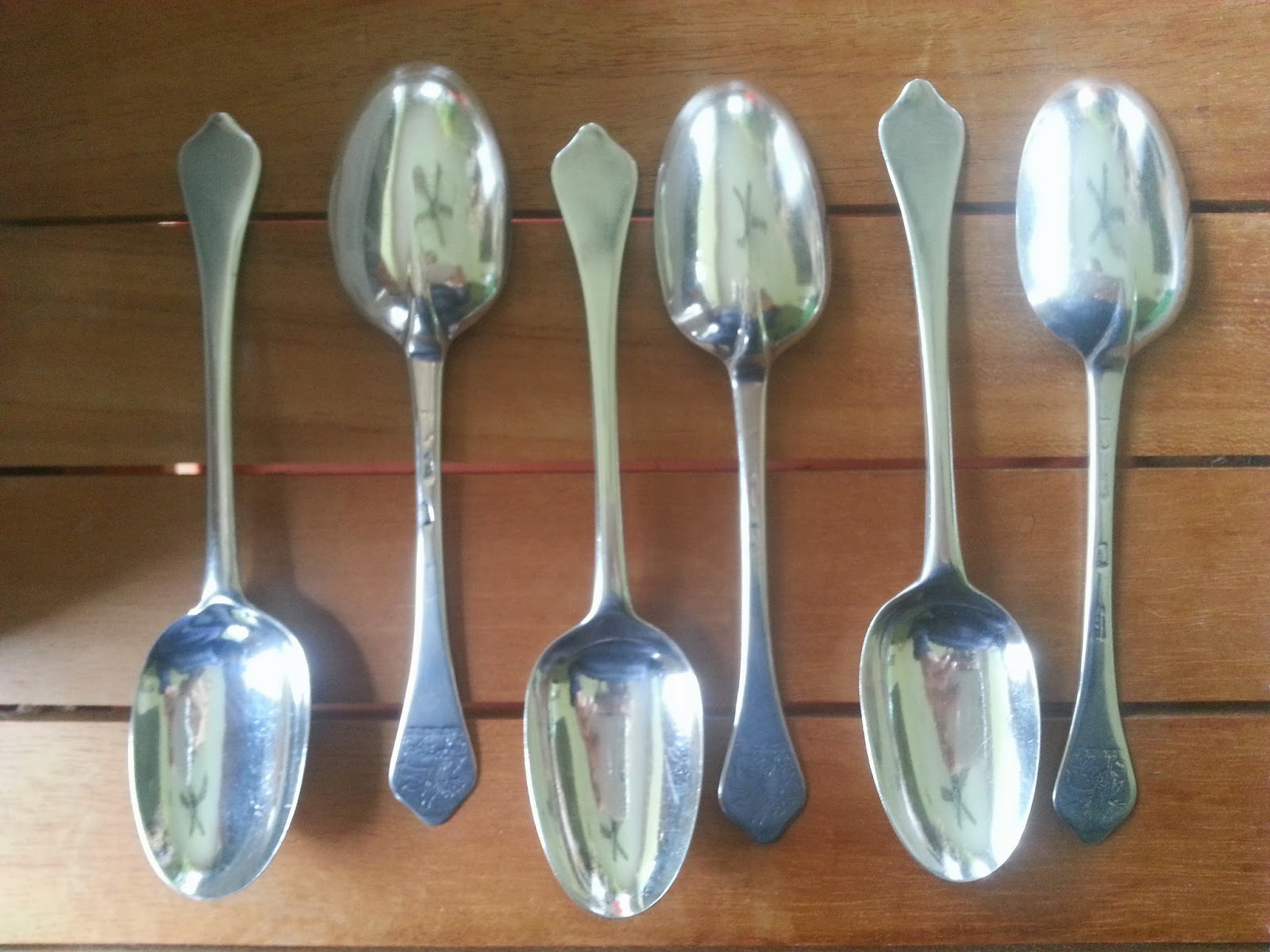
A few years ago, I bought a set of six Queen Anne dognose dessert spoons dating to 1702 by John Ladyman.  The spoons are 6 1/4" long and each is engraved with a wonderful crest of a griffin.  Confirming Mr. Clayton's remark, my set of dessert spoons has succumbed to wear and tear, with the hallmarks and the rattails being fairly worn.

Set of six dessert spoons, John Ladyman, London, 1702

Close-up of hallmarks on Ladyman dessert spoon

My spoons have seen their fair share of 'dessart,' so I'd like to think I've done Mr. Ladyman proud. And, I'm happy to find that, in Mr. Clayton's opinion at least, I own a set of rare spoons.

Spoon: John Ladyman, 1702.  Ice cream: Ben & Jerry's Half Baked.

Sources:
Bexfield, Daniel, ed. The Finial 22/02 (Nov/Dec 2011): 25. Web. 12 Oct. 2014.
Clayton, Michael. Christie's Pictorial History of English and American Silver.
       Oxford: Phaidon Christie's Limited, 1985. Print.

Delieb, Eric. Investing in Silver. New York: Clarkson N. Potter Inc., 1967. Print.

Sunday, October 26, 2014

The Life and Times of John Ladyman (with some Irish Gold Tea Implements Thrown in for Good Measure)

Maker's mark of John Ladyman
As readers of this blog know, I have a thing for silversmith John Ladyman.  I don't own a copy of Grimwade's London Goldsmiths, but as a member of The Silver Society, I have access to their database of information extracted from said tome.  Although I am sure the print version of Grimwade contains additional details, the information I can access shows that John Ladyman entered only one mark between January and July 1699 as a largeworker.  Between 1691 and 1713, Ladyman's address is listed as Sherborn Lane, and after 1724 it is listed only as London.  I do wonder why Ladyman entered as a largeworker, since the only pieces I have seen by him are spoons.

John Ladyman married Sarah Wilson on September 27, 1691 at St. James church in Duke's Place, London (Phillimore 39).  As far as I can interpret from The Transcripts of the Registers of the United Parishes of S. Mary Woolnoth and S. Mary Woolchurch haw, John and Sarah had six children:

- Elizabeth, baptized April 29, 1692 (based on the date of the marriage and Elizabeth's baptismal date, does this mean Sarah was pregnant when she married John?);
- John, baptized November 5, 1693 and died on January 31, 1694;
- Mary, baptized November 19, 1695;
- Thomas, baptized June 10, 1697;
- John, the only entry being that he was the "infant and son" of John Ladyman who died on November 10, 1697 and was buried on November 11; and
- John, baptized January 6, 1699
(Brooke and Hallen 77, 78, 80, 82, 85, 260, 264)

Since there is not a separate entry for the baptism of the John who died on November 10, 1697, I assume he was born and died the same day.  These entries also make me wonder how quickly after birth children at this time were baptized; take for instance the first John who was baptized just over 6 months after Elizabeth, implying - only if John was baptized very quickly after his birth - that Elizabeth was born at least three months before her baptism.  Same query with the birth-baptism intervals of Thomas and the second John.  Of course, there could also have been errors in the original registers or they could have occurred during transcription.  I am unable to find a record of John Ladyman's death.

Five gold teaspoons by John Ladyman, 1711, along with sixth teaspoon, sugar nips and mote spoon, Dublin post-1730.  Photograph credit: The Metropolitan Museum of Art, Gift of Mrs. Edward S. Harkness, 1927.  www.metmuseum.org

The most interesting pieces by John Ladyman that I have come across are a set of five teaspoons made of gold dating to 1711 in the collection of the Metropolitan Museum of Art.  The five Ladyman teaspoons are shown with another later teaspoon, a mote spoon, and a pair of sugar nips all made of gold and all made in Dublin post-1730.  Each piece is engraved with a K surmounted by an earl's coronet, which the museum states could possibly be for the Earl of Kerry, a title created in 1722.  Now, if there are five of these gold teaspoons, a sixth presumably existed at some point, since a half-dozen was the norm.  What happened to this sixth gold spoon?  Who commissioned John Ladyman to make these golden teaspoons in the first place?  If the MMA is correct and the engraving is for the Earl of Kerry, the engraving cannot be contemporary to the manufacture of the 1711 Ladyman teaspoons.  Was there an original engraving on the backs of the teaspoons that would have given us a clue to their first owner?


Gold teaspoon by John Ladyman, 1711.  Photograph credit: The Metropolitan Museum of Art, Gift of Mrs. Edward S. Harkness, 1927.  www.metmuseum.org

To date, my small collection of pieces by him includes three tablespoons, six dessert spoons, and two teaspoons, all in the Hanoverian rattail style.

Front and back of three tablespoons, 1712, two (of a set of six) dessert spoons, 1702, and two teaspoons, all by John Ladyman
Engravings on the terminals of John Ladyman spoons


Sources:
Brooke, J.M.S. and Hallen, A.W.C. The Transcript of the Registers of S. Mary Woolnoth and S. Mary Woolchurch, haw, in the City of London, from their 
      Commencement 1538 to 1760. London: Bowles & Sons, 1886. Google Books. Web. 11 Oct 2014.
Phillimore, W.P.W. and Cokayne, George E., eds. London Parish Registers. Marriages at St. James's , Duke's Place, From 1691 to 1700. Vol. III. London: Phillimore 
      & Co., 1901. Internet Archive. Web. 11 Oct 2014.

Saturday, October 11, 2014

Engraving on Flatware

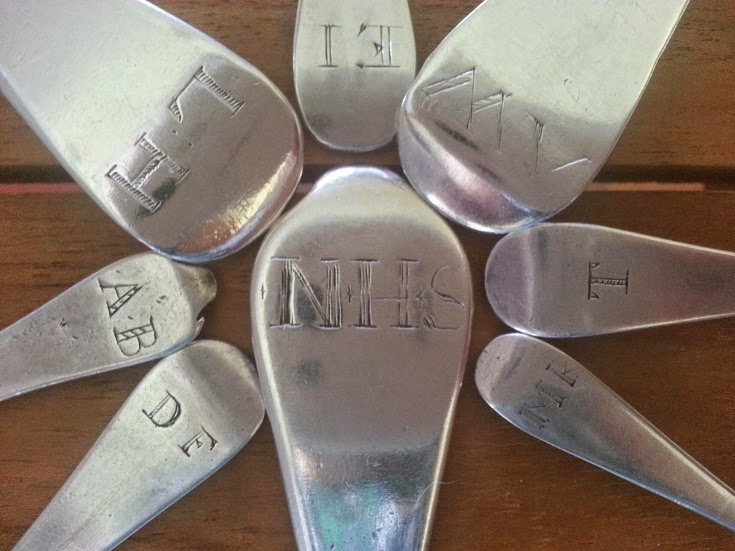
Following are photographs of the engravings on the backs of my spoons and forks (essentially a reprise of my first post with a few new additions).  Each of the engravings is unique, and has become an effective way to identify the utensil.  My husband's favorite spoon is the Owl Spoon.  I, of course, have several "favorites"...  Recently, I was excited to find a little teaspoon engraved "MK," M being the first letter of my name and K being that of my husband's.

Gary Bottomley of Antique Silver Spoons tells us that one set of initials, as on all of the flatware in the first photograph below, could indicate that the spoon was given as a birth, christening, or baptismal gift.  Or, the initials could be that of the adult owner, usually the man if he were married.  I assume a single set of initials could also be those of a single or widowed woman.

Whatever the type of engraving - initials, cypher, crest, coat of arms - it served to identify the owner of the piece.  In the most recent edition of The Finial, Robin Hunt sent in an ad from the March 7, 1694 edition of The London Chronicle, which offers a reward for information about a stolen silver spoon and fork identified as being engraved with a "Tygars Head."


What are your favorite engravings on your flatware? 

Initials:
 
Coat of Arms:

Cyphers:

Crests with Mottoes:

Crests - Mural Coronets:


Crests - Human Forms:

Crests - Animals:

Crests - Birds:

Sources:
 Bexfield, Daniel, ed. The Finial 25/01 (Sept/Oct 2014): 12. Print.