Wednesday, February 6, 2019

Provincial Silver Rattail Teaspoons? Please Help!

Hello, and a very happy 2019 to all of you!  I hope it has treated you well so far.

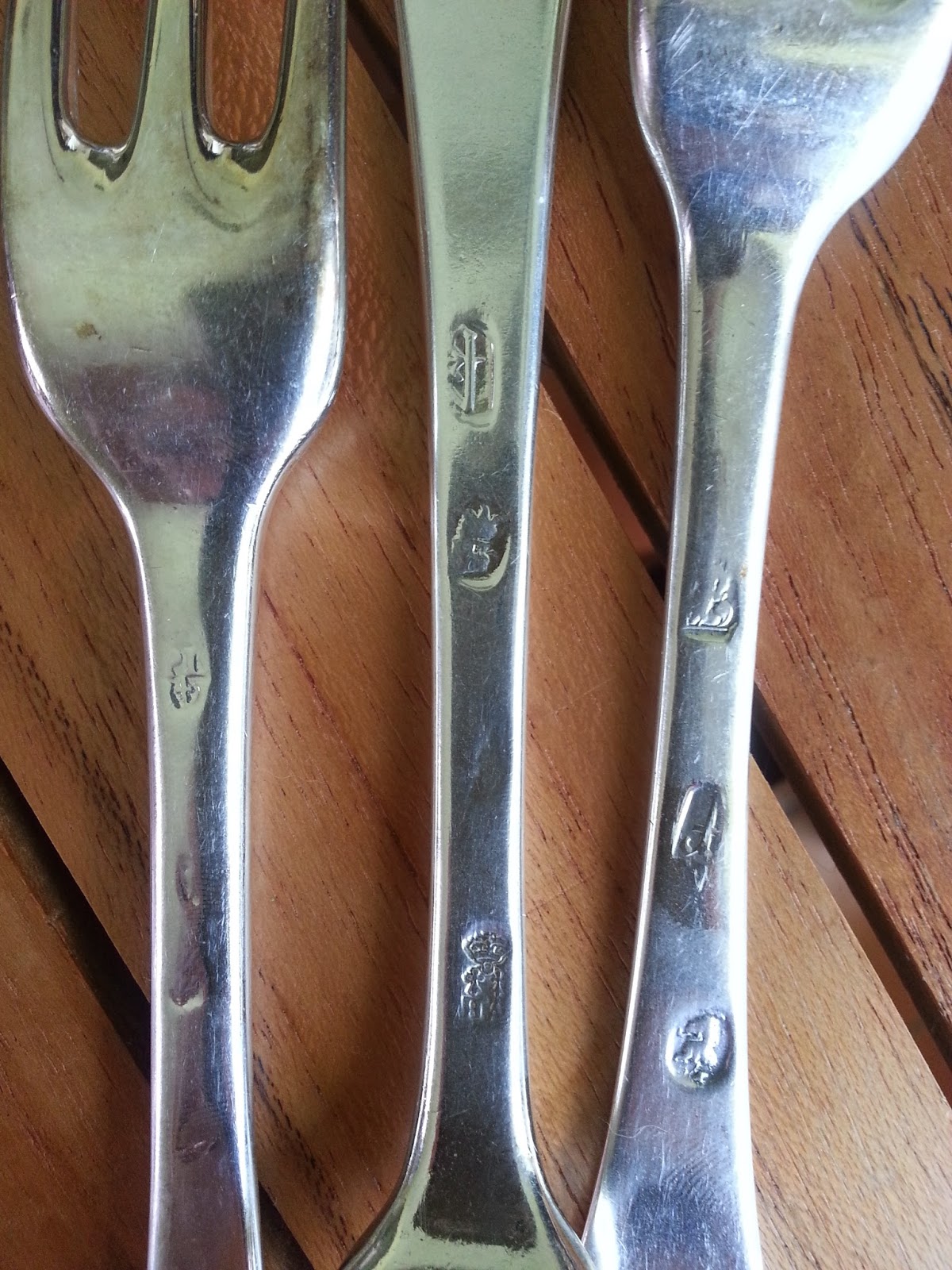
Below are photographs of three rattail  teaspoons I recently purchased.  Two are 11.5 cm, with the third 12 cm, and they are fairly light in weight.  As you can see, the marker's mark "AB" is struck three times on one spoon and once on each of the others.  Is anyone able to help me identify who the maker might be and where they were made?  Thank you very much!


Tuesday, December 12, 2017

Irish Silver Rattail Teaspoon - But is it Genuine?

I have long been wondering why I have not come across any early Irish rattail teaspoons.  Even knowing that Irish silver wasn't produced in the same numbers as English silver, I still thought I would have seen a few for sale over the years.  Am I simply looking in the wrong places?  Were Irish rattail teaspoons typically unmarked, or marked with the maker's mark only, meaning they are out there, but not of obvious Irish origin?  (Woolley & Wallis had one for sale in 2008 with maker's mark only, which they attributed to Anthony Semirot of Cork.)  Enter Exhibit A below:


I purchased this teaspoon several weeks ago.  Thin and light, with a worn and wonky bowl, it won't be featured on the cover of a book any time soon.  There are no initials or crest, but I also don't see signs of erasure.  The spoon handle is quite narrow, and I'm not sure if this is the way it was made or if it was trimmed down at some later point.

The maker's mark appears to be AL with a pellet between, which I have attributed to Anthony Lefebure.  Jackson's lists "spoon" as articles made by this silversmith, making this attribution slightly less tenuous.  The base of the crown is just visible above the letters.


The spoon is also stamped with the harp crowned and Hibernia.  Jackson's is very helpful, in that it has photographs of the Dublin silver hallmarks beginning with the 1720 date letter in its Appendix 1.  The Hibernia on this teaspoon matches very closely with the photograph of Hibernia depicted for the year 1731. 

So, is this the real deal?  Having been caught out once before buying a piece of fake Irish silver, I'm hoping it's not a case of "fool me twice, shame on me."

Sources:
Pickford, Ian, ed. Jackson's Silver & Gold Marks of England, Scotland & Ireland. 3rd ed., 1989. Woodbridge: 
       The Antique Collectors' Club, Ltd., 2011. Print.


Wednesday, November 2, 2016

Early Samuel Hitchcock Tablespoon

According to Jackson, Samuel Hitchcock entered his first mark in 1713 (Jackson 164).  Below are photographs of a Hitchcock tablespoon which bears the (rubbed but readable, difficult to photograph) date letter for 1713.


The tablespoon is of a nice, heavy weight and very balanced in the hand.  The initials ME on the back of the spoon probably date to post-1750, so there likely could have been an erasure of earlier initials or a crest, although I don't see signs of it.  Hitchcock entered his first mark in 1713, and I like that this spoon dates to the first year of Hitchcock's career.  There are three teaspoons by Hitchcock also in my collection, which you can read about here.

Sources:
Pickford, Ian, ed. Jackson's Silver & Gold Marks of England, Scotland & Ireland. 3rd ed., 1989. Woodbridge: 
       The Antique Collectors' Club, Ltd., 2011. Print.

Friday, October 21, 2016

Irish (?) Teaspoon of Frederick Hervey, 4th Earl of Bristol and Bishop of Derry

Frederick Augustus Hervey, 4th Earl of Bristol and Bishop of Derry

The Honorable Frederick Hervey (1730-1803) was ordained as a Fellow of Corpus Christi College, Cambridge in 1754, became a clerk of the Privy Seal in 1756, and was appointed a Royal Chaplain in 1763.  The Honorable and Reverend Frederick Hervey then undertook an extensive Grand Tour, and during his travels in Europe he further developed his passion for art.  In 1767, he was elected Bishop of Cloyne, and the following year he was translated as Lord Bishop of Derry.  Bishop Hervey succeeded to the title of the 4th Earl of Bristol in 1779.  Lord Bristol was elected a Fellow of the Royal Society in 1782 for his scientific exploration of Giant's Causeway, and received the Freedom of the City of Dublin and of Derry the next year. 

Below are photographs of a teaspoon which I believe belonged to Lord Bristol sometime after 1779, since it is engraved with both a bishop's mitre and the Earl of Bristol's crest.


The maker's mark, struck twice, appears to be CS, but I am having a difficult time finding a match to a silversmith.  Is this an Irish or an English maker?

Lord Bristol was said to have a fiery personality.  He favored religious equality, and financially supported construction of churches of other denominations.  He was also very political for a time, becoming active in the Irish Volunteer Movement and proposing in 1783, at a Volunteer National Convention in Dublin, legislative independence for the Irish Parliament.  This landed him in hot water and almost got him arrested by the British Government.  Hervey was an industrious and vigilant bishop, spending large sums of money building roads, bridges, and developing agricultural enterprise in his diocese and the city of Derry.  The Earl-Bishop took a lively interest in architecture and built homes at Downhill and Ballyscullion which he filled with works of art.  He also commissioned the Italian architect Asprucci to build Ickworth House, photo below, which was completed by his son Frederick in 1830.

Ickworth House (Photo by Squeezyboy on Flickr)
 
In 1752, the Hon. Frederick Hervey married Elizabeth Davers and had four sons and three daughters.  Perhaps their best-known daughter is Elizabeth who was the close friend of Georgiana Cavendish.  "Bess" lived with the Duke and Duchess and was a longtime mistress of the Duke, later becoming his second wife.

If anyone can offer a clue as to the maker of this teaspoon, it would be most appreciated!

Sources:
Blackwood, Loretto. "Early Bishop - Frederick Augustus Hervey."  Web blog post. Earl Bishop  Hervey. Blogger, 7 Oct 2013. Web. 21 Oct 2016.
"Frederick Hervey, 4th Earl of Bristol." Wikipedia, The Free Encyclopedia. Wikimedia Foundation, Inc., 13 Dec 2013. Web. 21 Oct 2016.
"Ickworth House." Wikipedia, The Free Encyclopedia.  Wikimedia Foundation, Inc., 27 Mar 2005. Web. 21 Oct 2016.
 

Wednesday, October 19, 2016

Charles II Silver Teaspoon

This tea (or coffee?) spoon ticked a few of my collecting boxes: made 300 years before I was born, fully-marked, useful.  The little spoon measures a shade under 3 7/8 inches.  The rattail is very worn on the back of the bowl, and the leading edge of the bowl is slightly curled. 


The teaspoon dates to 1678, and I believe is a bit unusual in that it is fully hallmarked.  In the July/August 2016 issue of The Finial, Granville Gregg poses several questions about English teaspoons, one of which is "When was the first English teaspoon made and by and for whom?"  Eric Delieb, in his Investing in Silver, illustrates a fully-marked Charles II teaspoon bearing the date letter for 1679 (Delieb 18) (which appears to have been most recently sold by Shrubsole). 


Although the maker's mark is not fully visible, it could be IM, a match for which I have not come across in Jackson's, or possibly IK for John King who Jackson identifies as a specialist spoonmaker whose mark is found on spoons between 1667 and 1683 (Jackson 127).

Do any other collectors out there have early fully-hallmarked teaspoons in their collection?

Sources:
Delieb, Eric.  Investing in Silver. New York: Clarkson N. Potter Inc., 1967. Print.
Gregg, Granville. "Musings on Spoon Volumes - Part I." The Finial 26/06 (Jul/Aug 2016). Print. 
Pickford, Ian, ed. Jackson's Silver & Gold Marks of England, Scotland & Ireland. 3rd ed., 1989. Woodbridge: 
       The Antique Collectors' Club, Ltd., 2011. Print.

Help Identifying a Mark on a Trefid Spoon

I am hoping that someone out there will stumble upon this post and be able to help identify the maker's mark on this trefid spoon.  The maker's mark appears to be a chicken head struck three times.  The terminal is dot-pricked MW over 1701.

Any help you can offer would be most appreciated!


Wednesday, September 21, 2016

Early Silver Dognose Forks

On January 4, 2014, I asked the question: What does a girl have to do to get some Britannia-standard forks?  When I posed my earlier question, I really had "Britannia-standard forks from the Queen Anne period with a Hanoverian terminal" type of forks in mind, but when I came across the four forks below, I found I was quite happy with the dognose terminal.  They are all delightfully heavy and a pleasure to use.  My favorite has to be the four-tined fork, a form that has been on my wish-list for quite some time.

Left to right: maker unknown, 1701; Pierre Harache, 1705; pair, makers mark of Pierre Platel visible on one only, date letter rubbed but appears to be 1714 (which seems somewhat late for the style)
Following are close-ups of the hallmarks and engravings:

Left to right: Mark of Pierre Platel, Pierre Harach, unknown maker.  I particularly like the lion's head erased on the fork on the right.
Crest and arms on forks
The only arms I know anything about are those on the fork pictured above at 6 o'clock.  This fork bears the arms of Frowde with Ashburnham in pretence, for the marriage of Margaret Ashburnham to Sir Philip Frowde.  Margaret was Philip's third wife, and by her had fours sons, Ashburnham, Peter, William and Michael.  Philip died in on August 6, 1674 and is buried in Bath Abbey Church. 


Sir Philip Frowde was appointed as manager of the General Post Office by the Duke of York and acted as agent for its lessee, Katherine, Countess of Chesterfield (Bell 203) during the time of the Great Fire in London of 1666.  In Unknown London, Bell notes that "Frowde and his lady anxiously watched the Fire bearing toward them, and at midnight, when the peril had become grave, they fled for safety" (Ibid.).  This would seem to suggest that Sir Philip and his family lived, at least part of the time, in rooms at the General Post Office.  Sir Philip Frowde's will identifies him as being in possession of the Rectory, or "Sheafe," of Welcombe in Devon and an Adventurer in the African Royal Company (Hooppell 456).


Sources:

Bell, Walter George. Unknown London. John Lane, 1922.  Google Books. Web. 21 September 2016.
Hooppell, Rev. R.E. "The Froudes, or Frowdes, of Devon." Report and Transactions of the Devonshire Association for the Advancement of Science, Literature, and 
      Art, Vol. XXIV, pp. 441-457. William Brendon and Son, 1892. Google Books. Web. 21 September 2016.